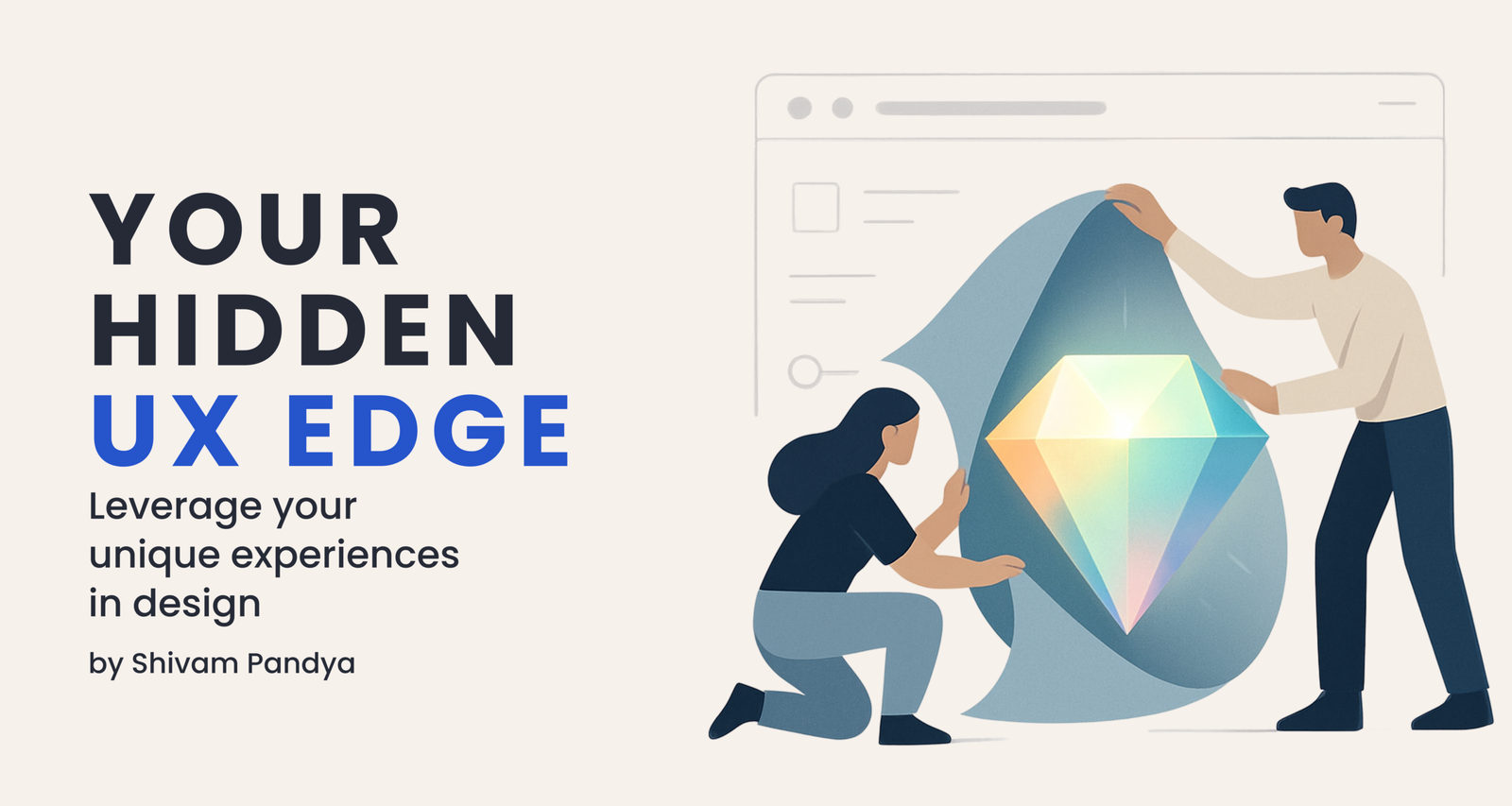
Hi, I’m Shivam Pandya, and for me, the journey into UX design has been anything but traditional. Coming from the world of social media content, I often felt like the skills I’d honed were invisible to the very people who needed them most in the UX field. If you, too, are a UX designer with a ‘non-traditional’ background — what we’re calling an “Accidental UXpert” — you’re far from alone. Let’s talk about the often-challenging transition from a different industry into the world of UX & Product Design. Does it sometimes feel like the right decision, and other times completely wrong? Perhaps by sharing our journeys, we can offer encouragement and illuminate the immense, often unrecognized, value these Accidental UXperts bring.
- We seize opportunities to innovate and grow
- We are one firm with a shared sense of purpose
- We care about each other and the world around us
The Untapped Potential: My Journey In
I’ve been navigating the UX landscape for a couple of years now, and frankly, the number of projects I’ve completed might seem small to some. But the reality is, some of those projects were deep dives that spanned months.
Before this, I spent a good chunk of time in the social media content industry. There, I gained invaluable experience in understanding content nuances, diverse user bases, regional differences, quality standards, and a whole lot more. I spent a couple of years immersed in that world, but my mind was always gravitating towards innovation and finding ways to improve things. Eventually, I decided to channel those skills into web design.
Have I mentioned that I was an IT dropout? Well, does that even matter? For an Accidental UXpert, every experience, even seemingly unrelated ones, contributes to their unique perspective. While the overall education wasn’t the right fit or particularly interesting for me, I did pick up some foundational skills during my time there. That unexpectedly gave me a broader perspective in my current work. How? Well, I’ll get to that soon.
Continuing my history, web design, as it often does, required code, and that wasn’t exactly my cup of tea. So, I naively thought, “Let’s just design, and someone else will handle the coding!” (Little did I know that “designing” is an actual profession!). Thinking back to my school days, arts and digital products always piqued my interest — a seemingly dormant seed that would eventually blossom in the realm of user experience.
But one more thing to add: I started building websites (mostly using drag-and-drop WordPress builders) before transitioning into content. Anyway, fast forward to 2023, I stumbled upon a Udemy course that promised to teach me Figma — a tool that would finally let me bring my design ideas to life digitally. I didn’t even realize the title also included “UI Design.” That was a turning point, a literal ray of hope in what felt like a dark tunnel, propelling this Accidental UXpert towards a field that finally resonated with my inherent drive to understand the “Why” behind things. This curiosity led me to devour courses, articles, and videos, and even to experiment with the nascent AI chatbots to gain diverse UX perspectives.
The Hiring Hurdle: A Tale of Misunderstanding
Now, circling back to the million-dollar question: Does my diverse background actually going to work for me? The frustrating truth, as many Accidental UXperts discover, is that the job search can feel like an uphill battle. I diligently applied to numerous places for designer roles, junior positions, even internships. And the frequent result? It often felt like no one really wanted to take a chance on me. I was utterly confused. What was I doing wrong? The courses had emphasized building a portfolio, so I poured months into creating what I thought were compelling, large-scale projects, only for them to seemingly land on deaf ears.
It slowly dawned on me that my specific region doesn’t always grasp the true value of UX. They want to hire for “UX” because it’s trendy, but the fundamental understanding of what user experience truly entails seems to be missing. For many companies, it’s just about hiring a few “experts” who will ultimately execute their vision, often without a user-centric approach.
My own job search was filled with moments that highlighted this very disconnect. In one memorable interview, after diligently explaining my career journey, the projects I’d poured my heart into, and the tangible outcomes I’d achieved, I was met with blank stares fixated on my portfolio. It felt as though the interviewers were either ill-equipped to judge the work or simply uninterested in understanding the thought process behind it.
The next step was even more telling. The creative lead, without any context, simply instructed me to ‘design the hero, contact, and one more section’ for a new client’s website, offering no information about screen sizes or grid systems. When I inquired about these basic requirements, the answer was a curt ‘12.’ Twelve what? Pixels? Columns? It was baffling.
Undeterred, this Accidental UXpert took the initiative to analyze the client’s existing website — a complete mess, frankly. Drawing on my content knowledge and marketing perspective, I spent two hours crafting three key pages. I restructured the information flow to align with the website’s lost goals and integrated clear lead-generating calls to action.
Now, when I informed him that I was done, he was surprised. Then they talked for half an hour and invited me back to the cabbine for an interview. Now they say you did a nice job, but we didn’t ask for three pages. I was like, huh? I designed what that thing needs to function. I spent time explaining my design thinking, but at the end, they are like This is very simple. Then I realised these idiots have no idea about ux, but they are looking for someone who can visually enhance things for them.
In design, I created some components, but it was time taking so I used premade components from libraries, and now their point was “we are authentic, we don’t use premade things.” When I asked for their design system, they had no idea lol. I was shocked and laughing at myself like what I’m even doing here. He was offering me not even half of my previous salary, and still wants to hire me. This experience perfectly illustrated how some companies, despite wanting to hire a ‘UX designer,’ fundamentally misunderstand the discipline and fail to appreciate the value of diverse skills and strategic thinking that Accidental UXperts often possess.
Look, I worked in companies and I understand business. For me, if my employee is masterd or at least aware of multiple industries that going to impact work. Sure, in some cases, it might hinder authorities if they want you to just work on one thing blindly. But this is a creative field, you will be going to have people who are creative and experienced in some manner — the Accidental UXpert is a prime example.
The Value Proposition: What “Accidental UXperts” Bring
For the Aspiring “Accidental UXpert”:
If you’re reading this and nodding along, feeling like your unique background is being overlooked, here are a few things to keep in mind:
- Own Your Narrative: Don’t downplay your previous experiences. Instead, actively translate those skills into UX terminology in your portfolio and during interviews. For example, if you were a teacher, highlight your communication and empathy skills in the context of user research and user-centered design. While you might have mentioned previous experience in your resume but that might not be enough for an interviewer to understand. So, make sure to elaborate on that and how it will impact work and the company.
- Show, Don’t Just Tell: Use your portfolio to showcase projects where you’ve applied your unique skills. If you come from a marketing background, perhaps a project focusing on user acquisition flows would be a great fit.
- Connect the Dots Explicitly: During interviews, don’t assume the interviewer will see the relevance of your past roles. Clearly and concisely explain how your previous experience gives you a distinct advantage in understanding users, solving problems, or approaching design challenges.
- Find Your Niche: Your unique background might make you particularly well-suited for a specific area of UX. For example, someone with a background in healthcare might excel in designing health tech products. Explore those intersections.
- Network Strategically: Seek out UX communities and professionals who value diverse backgrounds. Share your story and learn from others who have made similar transitions.
Well, companies should realise that they should have a diverse team or at least give it a try. It might not be easy to handle, but it will bring you more perspectives and not work like machines in the creative field. Basically helps your client’s business, and so does yours. By overlooking these Accidental UXperts, you might be missing out on individuals who bring invaluable, real-world experience and a fresh lens to the design process. Ultimately, embracing this diversity leads to better user experiences for your clients, which directly translates to success for your own business. Don’t get stuck in the echo chamber of conventional hiring; explore the immense potential of the Accidental UXpert.
Your past studies and professional experiences are absolutely not a waste in this industry. The field we work in is all about improving things, so whatever experiences you bring to the table are likely to be helpful in some way. You’ll probably realize that you have a natural edge in certain areas compared to your peers. A team with diverse backgrounds, including numerous Accidental UXperts, is often better equipped to create user experiences that truly understand and cater to different perspectives.
A Call to Action: For Individuals and Companies
So, to all the Accidental UXperts out there: your journey is valid, and your diverse experiences are your strength. Don’t let narrow-minded hiring practices dim your passion. And to companies: open your eyes to the wealth of talent that lies beyond the traditional UX profile. Embrace the unique perspectives of the Accidental UXpert — it’s not just about being inclusive; it’s about building more innovative, user-centered, and ultimately, more successful products.
About Me: I’m Shivam Pandya, an aspiring Product Designer with a background in the dynamic world of social media content. My journey into UX has been unconventional, and I believe those diverse experiences offer a unique lens on user-centered design. I’m passionate about understanding the ‘why’ behind user behavior and building intuitive, impactful products. Connect with me on my Linkedin or explore my design journey at Evoxal.Design.